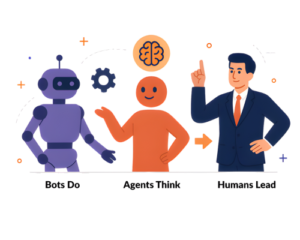
AI-powered automation combines artificial intelligence technologies, such as machine learning, natural language processing, and computer vision, with robotic process automation to handle complex tasks with minimal human intervention. Unlike traditional automation that follows fixed rules, AI automation learns from data, adapts to changes, and makes intelligent decisions, reducing operational costs by 30-40% while improving accuracy and efficiency.
According to McKinsey’s 2025 research, 92% of companies plan to increase AI investments by 2028.
Quick Takeaways
- Cost Savings: AI automation reduces operational costs by 30-40% on average
- Productivity Boost: Employees can safely automate up to 3 hours of daily tasks
- Market Growth: AI automation market projected to grow to $423 billion at a CAGR of 26.9%.
- ROI Timeline: Most businesses achieve return on investment within 6-12 months
- Adoption Rate: 88% of enterprises now use AI-powered automation in some capacity
Definition of AI-powered automation
AI-powered automation uses artificial intelligence technologies to automate tasks, analyze data, and make decisions with minimal human intervention. It enables systems to learn, adapt, and improve over time, handling complex and dynamic processes more efficiently than traditional automation.
What is AI-Powered Automation?
AI-powered automation integrates artificial intelligence technologies into automation systems to perform tasks, streamline workflows, and optimize processes with minimal or no human intervention. This approach goes beyond traditional automation, which relies on predefined rules, by enabling systems to learn from data, adapt to changing conditions, and make intelligent decisions.
At its core, AI-powered automation leverages advanced capabilities like machine learning, natural language processing, and computer vision to handle complex, dynamic, and unstructured tasks that conventional automation tools once found too challenging.
How AI-Powered Automation Differs from Traditional Automation
Traditional Automation | AI-Powered Automation |
Follows fixed, rule-based processes | Learns from data and improves over time |
Cannot adapt to exceptions or changes | Adapts to new situations automatically |
Requires manual updates for new scenarios | Handles unstructured data (text, images, speech) |
Best for simple, repetitive tasks | Makes context-aware decisions |
Limited to structured data | Scales to complex, dynamic processes |
The power of AI in automation lies in its ability to process and analyse vast amounts of data in real-time, identify patterns, predict outcomes, and provide actionable insights. For example, AI-powered systems can assess customer behaviour to deliver personalized experiences, detect anomalies in processes to prevent errors, or forecast market trends to inform business strategies.
By integrating AI into automation, businesses achieve greater efficiency and scalability while reducing manual effort and human error. AI-powered systems evolve over time, learning from new data and continuously improving their performance. This adaptability makes them highly versatile and effective across various industries.
Key Components of AI-Powered Automation
Key Components of AI-powered Automation
- Artificial Intelligence (AI): AI acts as the “brain” of intelligent automation, using machine learning and complex algorithms to enable systems to learn, adapt, and make decisions.
- Robotic Process Automation (RPA): RPA uses software bots to automate repetitive and manual tasks, improving efficiency.
- Business Process Management (BPM): BPM automates workflows to improve agility, consistency, and efficiency in business processes.
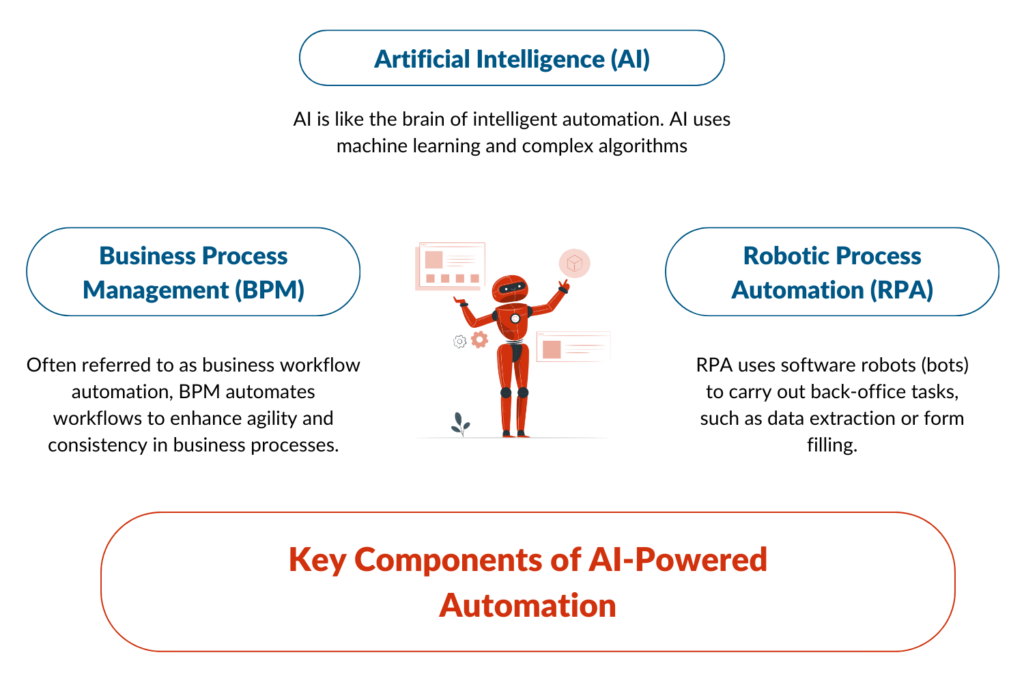
Businesses can use AI with process automation to improve their automation through AI-powered automation. In this section, we will talk about the key components of AI-powered automation.
Artificial Intelligence (AI)
Artificial Intelligence (AI) can be likened to the brain of intelligent automation. It performs tasks requiring human-like intelligence, including understanding language, recognizing patterns, and problem-solving. This is achieved through machine learning and complex algorithms that analyze and interpret all data types.
AI can create a thorough knowledge base in business from accumulated data, such as customer interactions and sales data. It identifies patterns and trends, providing important insights. These insights can predict future trends and behaviours, aiding business strategy and decision-making. Therefore, AI is more than an automation tool, it’s a strategic planning resource.
Business Process Management (BPM)
Business Process Management (BPM) is a strategy for managing and improving company workflows. By automating these processes, businesses become more agile and can quickly adapt to changes. BPM also reduces the chance of errors by ensuring consistency in process execution. Used in a wide range of industries, BPM streamlines operations to save costs and increase productivity. It also improves customer and employee experiences by making all processes run smoothly. In today’s competitive business world, BPM is essential for efficient operation.
Robotic Process Automation (RPA)
Robotic Process Automation (RPA) is a technology that utilizes software robots, commonly referred to as bots, to automate routine back-office tasks. These tasks can include a variety of functions such as data extraction or filling out forms. These software robots are designed to mimic human actions and are capable of executing tasks quickly and accurately, thereby increasing productivity and efficiency. These bots do not work in isolation, but rather in tandem with Artificial Intelligence (AI) technologies.
The integration of RPA with AI enables these bots to handle more complex tasks and use cases. This includes understanding natural language, making decisions based on predefined criteria, learning from past actions, and even predicting future trends. This combination of RPA and AI is transforming the way businesses operate by automating repetitive tasks and freeing up human resources for more strategic, value-added roles.
Benefits of AI-Powered Automation
Benefits of AI-Powered Automation
- Increased Efficiency and Productivity
- Significant Cost Savings
- Enhanced Accuracy and Quality
- Scalability Without Proportional Cost Increases
- Improved Customer Experience
- Better Decision-Making with Data Insights

1. Increased Efficiency and Productivity
AI-powered automation handles tasks faster and more accurately than humans, resulting in significant productivity gains. McKinsey’s research indicates that generative AI alone could add $4.4 trillion in value to the global economy through productivity gains.
Employees using AI automation report saving up to 3 hours per day on routine tasks, allowing them to focus on strategic, creative work that drives business value.
2. Significant Cost Savings
Automating routine tasks reduces labour costs and operational expenses. AI-driven systems work around the clock without breaks, further increasing cost efficiency. Organizations typically see 30-40% reduction in operational costs within the first year of implementation.
Beyond direct labour savings, AI automation reduces costs associated with human error, compliance violations, and inefficient processes.
3. Enhanced Accuracy and Quality
AI systems process large volumes of data with high precision, making them ideal for data analysis, financial forecasting, quality control, and compliance monitoring. Unlike humans, AI doesn’t experience fatigue or distraction, maintaining consistent accuracy even during high-volume periods.
In manufacturing, AI-powered quality control systems detect defects with 99%+ accuracy. In healthcare, diagnostic AI reduces errors by up to 15% compared to traditional methods.
4. Scalability Without Proportional Cost Increases
AI-powered solutions easily scale operations to handle growing workloads without corresponding increases in costs or staff. This is particularly beneficial for businesses experiencing rapid growth or seasonal demand fluctuations.
A customer service team of 10 agents can handle 100 inquiries per day. Add AI chatbots, and the same team can manage 1,000+ inquiries without adding headcount.
5. Improved Customer Experience
AI provides personalized customer service, predicting needs and offering tailored solutions. AI-powered chatbots and virtual assistants offer 24/7 support, instant responses, and quick issue resolution.
In this fast-paced world, customers expect immediate, personalized service. AI automation delivers this at scale, analysing customer history, preferences, and behaviour to provide contextually relevant interactions.
6. Better Decision-Making with Data Insights
AI analyses massive datasets to surface insights humans might miss. It identifies trends, predicts outcomes, and recommends actions based on historical patterns and real-time data.
Business leaders using AI-powered analytics make faster, more informed decisions. Instead of waiting days for manual reports, they access real-time dashboards showing key metrics, forecasts, and anomalies.
Real-World Use Cases of AI-Powered Automation
AI-powered automation is transforming industries worldwide. From detecting fraud in real-time to predicting equipment failures before they occur, organizations across sectors are leveraging intelligent automation to streamline operations, reduce costs, and deliver superior experiences. Here are six industries leading the AI automation revolution.
Real-World Use Cases of AI-Powered Automation
- Finance
- Fraud Detection & Prevention
- Credit Assessment & Loan Processing
- Compliance and Regulatory Reporting
- Manufacturing
- Predictive Maintenance
- Quality Control
- Supply Chain Optimization
- Healthcare
- Clinical Decision Support & Diagnostics
- Administrative Automation
- Predictive Analytics
- Personalized Treatment Plans
- Retail
- Intelligent Inventory Management
- Demand Forecasting
- Personalized Shopping Experiences
- Dynamic Pricing
- Marketing
- Consumer Behavior Analysis
- Automated Content Creation
- Campaign Performance Optimization
- Predictive Lead Scoring
- Customer Service
- Intelligent Chatbots & Virtual Assistants
- Automated Ticket Routing
- Sentiment Analysis
- Proactive Support
Finance
AI-powered automation is revolutionizing financial services in 2025, particularly in:
- Fraud Detection & Prevention: AI analyses transaction patterns in real-time, with machine learning algorithms identifying unusual behaviours like unexpected large transactions or purchases from unfamiliar locations. Financial institutions respond rapidly to potential fraud, protecting customers before significant damage occurs.
Major banks now detect fraudulent transactions with 95%+ accuracy, reducing false positives by 60% compared to rule-based systems. This means fewer legitimate transactions get blocked while catching more actual fraud.
- Credit Assessment & Loan Processing: AI evaluates loan applications by analysing credit scores, income levels, spending habits, employment history, and thousands of other data points to assess risk efficiently. What once took 5-7 days now happens in hours or minutes.
Robo-advisors like Betterment and Wealthfront use AI to provide personalized investment advice based on individual financial goals, risk tolerance, and market conditions. These platforms manage billions in assets, making sophisticated financial planning accessible to everyday investors.
- Compliance & Regulatory Reporting: With 58% of finance leaders still relying on manual tools like Excel, AI automation addresses critical needs in compliance management. AI monitors transactions for suspicious activity, generates regulatory reports, and ensures adherence to constantly evolving financial regulations.
ROI Impact: Financial institutions implementing AI automation report average annual savings of $5.4M through reduced fraud losses, faster processing, and improved compliance.
Finance
AI analyzes transaction patterns in real-time to detect fraud with 95%+ accuracy while reducing false positives by 60%. Financial institutions respond rapidly to potential fraud, protecting customers before significant damage occurs.
- Automated loan processing in hours vs. days
- Real-time fraud detection and prevention
- Compliance monitoring and reporting
- Credit risk assessment automation
Manufacturing
AI-driven automation in manufacturing transforms operations through:
- Predictive Maintenance: AI monitors equipment sensors 24/7, detecting subtle changes that signal potential failures. Instead of reactive repairs or wasteful scheduled maintenance, manufacturers fix problems before they cause downtime.
Companies like Siemens and General Electric use AI to predict equipment failures days or weeks in advance, minimizing downtime and repair costs. One automotive manufacturer reduced unplanned downtime by 35% and maintenance costs by 25% using AI predictive maintenance.
- Quality Control: Computer vision AI inspects products on assembly lines at speeds impossible for humans, detecting defects as small as microns. In semiconductor manufacturing, AI inspects hundreds of wafers per hour with 99.9% accuracy.
- Supply Chain Optimization: AI forecasts demand, optimizes inventory levels, and identifies supply chain disruptions before they impact production. During the 2024-2025 period, manufacturers using AI supply chain tools weathered global disruptions 40% better than competitors.
ROI Impact: Manufacturers report 20-30% reduction in maintenance costs, 15-25% improvement in product quality, and 10-15% increase in overall equipment effectiveness (OEE).
Manufacturing
AI monitors equipment sensors 24/7, detecting subtle changes that signal potential failures. Computer vision inspects products at speeds impossible for humans, detecting defects with 99.9% accuracy.
- Predict equipment failures days in advance
- Computer vision quality inspection
- Supply chain optimization
- Real-time production monitoring
Healthcare
AI automation transforms healthcare delivery across multiple areas:
- Clinical Decision Support & Diagnostics: AI analyses patient histories, lab results, and medical imaging to suggest diagnoses and treatment plans. Cancer Centre. AI’s platform enables physicians to digitize pathology scans and use AI models for analysis, resulting in 15% reduction in diagnostic errors during pilot studies.
IBM Watson assists doctors in diagnosing complex cases by analysing vast medical databases, clinical studies, and patient records in seconds. It highlights potential diagnoses and relevant research, augmenting physician expertise.
- Administrative Automation: Healthcare systems waste tremendous resources on paperwork. AI automates patient intake, insurance verification, appointment scheduling, medical coding, and billing. Chi Mei Medical Centre deployed generative AI assistants that reduced administrative workloads for doctors, nurses, and pharmacists by 40%.
- Predictive Analytics: AI forecasts patient admission rates, disease outbreaks, and resource needs, helping hospitals optimize staffing and inventory. One Chicago hospital reduced ER wait times by 28% using AI-powered patient flow prediction.
- Personalized Treatment Plans: AI analyses genetic data, medical history, and treatment responses to recommend personalized care plans. This precision medicine approach improves outcomes while reducing trial-and-error in treatment selection.
ROI Impact: Healthcare organizations implementing AI automation report $3.2M average annual savings through reduced errors, improved efficiency, and better patient outcomes. More importantly, patient satisfaction scores increase by 15-20%.
Healthcare
AI analyzes patient histories, lab results, and medical imaging to suggest diagnoses and treatment plans. Healthcare systems automate patient intake, insurance verification, and appointment scheduling.
- AI-powered diagnostic assistance
- Automated patient intake and scheduling
- Predictive patient admission forecasting
- Personalized treatment recommendations
Retail
AI-powered automation helps retailers compete in an increasingly digital marketplace:
- Intelligent Inventory Management: AI tracks inventory in real-time, predicts demand patterns, and automatically triggers reorders. Systems combine robots with computer vision to scan shelves, detect anomalies, and update stock levels continuously.
inVia Robotics’ Goods-to-Person systems let robots pick and move items throughout warehouses without human intervention, operating 24/7. E-commerce businesses report productivity improvements up to 5x, processing orders faster while cutting labour costs.
- Demand Forecasting: AI analyses historical sales, seasonal trends, weather patterns, social media sentiment, and economic indicators to predict what products customers will want and when. Retailers reduce stockouts by 30% and overstock by 25% using AI demand forecasting.
- Personalized Shopping Experiences: AI analyses customer preferences, browsing history, and purchasing patterns to recommend products. Like Netflix recommends shows based on viewing history, retail AI suggests products customers are likely to purchase.
Amazon’s recommendation engine drives 35% of total revenue. Smaller retailers using AI personalization see 10-15% increases in average order value and 20-25% improvements in conversion rates.
- Dynamic Pricing: AI adjusts prices in real-time based on demand, competition, inventory levels, and customer segments, optimizing revenue while remaining competitive.
ROI Impact: Retailers implementing AI automation report 15-20% increase in sales, 25-30% reduction in excess inventory costs, and 10-15% improvement in profit margins.
Retail
AI tracks inventory in real-time, predicts demand patterns, and automatically triggers reorders. Systems combine robots with computer vision to scan shelves and update stock levels continuously.
- Real-time inventory tracking
- AI-powered product recommendations
- Dynamic pricing optimization
- Automated warehouse robotics
Marketing
AI transforms marketing from guesswork to science:
- Consumer Behaviour Analysis: AI analyses millions of data points about customer behaviour, preferences, and engagement patterns. It identifies micro-segments within audiences and predicts which messages will resonate with each group.
- Automated Content Creation: AI tools generate initial content drafts, social media posts, email subject lines, and ad copy. While human marketers add strategic thinking and brand voice, AI handles repetitive content variations at scale.
One SEO agency doubled article volume from 80 to 160 per month using AI content automation, saving 85 hours monthly and freeing the team for strategy work.
- Campaign Performance Optimization: Platforms like HubSpot and Salesforce use AI to optimize marketing efforts and improve ROI. AI automatically adjusts ad spend, targeting, and messaging based on real-time performance data.
- Predictive Lead Scoring: AI analyses prospect behaviour to predict which leads are most likely to convert, helping sales teams prioritize outreach. Companies using AI lead scoring see 30% shorter sales cycles and 20% higher win rates.
ROI Impact: Marketing teams report 25-35% improvement in campaign performance, 40-50% reduction in cost per acquisition, and 20-30% increase in marketing ROI.
Marketing
AI analyzes millions of data points about customer behavior, preferences, and engagement patterns. It identifies micro-segments and predicts which messages will resonate with each group.
- Predictive lead scoring
- Automated content generation at scale
- Real-time campaign optimization
- Micro-segment audience targeting
Customer Service
AI revolutionizes customer service by handling routine inquiries while freeing human agents for complex issues:
- Intelligent Chatbots & Virtual Assistants: Modern AI chatbots understand context, sentiment, and intent. They handle thousands of simultaneous conversations, providing instant responses 24/7.
Companies like Google and Microsoft deploy AI-driven chatbots that resolve 60-70% of customer inquiries without human intervention. Common questions about returns, order status, password resets, and product information get instant answers.
- Automated Ticket Routing: AI analyses support tickets and automatically routes them to the right team or agent based on issue type, urgency, and required expertise. This reduces resolution times by 40-50%.
- Sentiment Analysis: AI monitors customer interactions for frustration or satisfaction, alerting supervisors when conversations need intervention or highlighting opportunities for improvement.
- Proactive Support: AI predicts when customers might need help—detecting abandoned carts, usage patterns suggesting confusion, or behaviours indicating churn risk—and proactively offers assistance.
ROI Impact: Organizations report 50-60% reduction in support costs, 40% faster average resolution times, and 15-20% improvement in customer satisfaction scores.
Customer Service
Modern AI chatbots understand context, sentiment, and intent. They handle thousands of simultaneous conversations, providing instant responses 24/7 while freeing human agents for complex issues.
- 24/7 instant customer responses
- Automated ticket routing
- Sentiment analysis and proactive support
- Handle thousands of inquiries simultaneously
Top AI-Powered Automation Platforms for Enterprises (2025)
Selecting the right AI-powered RPA platform is critical for automation success. Here are the leading enterprise-grade solutions combining RPA with advanced AI capabilities:
1. UiPath – Best for Comprehensive AI-Driven Automation
UiPath continues to dominate the RPA market as the largest vendor by revenue. The UiPath Business Automation Platform integrates RPA with AI, natural language processing, API automation, and intelligent document processing.
AI Technology: UiPath uses proprietary UiPath Autopilot and specialized large language models (LLMs) for AI-augmented development and operations. The platform is developing Large Action Models (LAMs) to further improve automation precision.
Key Capabilities:
- Document Understanding for invoice and contract processing
- Process Mining to discover automation opportunities
- AI Centre for building custom ML models
- Cloud-native platform with robust scalability
- Support for both technical developers and citizen developers
Best For: Large enterprises needing end-to-end automation with advanced AI capabilities
Pricing: Enterprise-level (premium pricing, contact for quote)
Ecosystem: Over 10,000 enterprise customers, 6,000 systems integrator partners, and 1.1 million users in UiPath Academy
2. Microsoft Power Automate – Best for Microsoft Ecosystem Integration
Microsoft Power Automate leverages the Microsoft Azure cloud platform to deliver comprehensive automation across desktop and cloud environments. It’s particularly powerful for organizations invested in Microsoft 365, Dynamics, and Azure.
AI Technology: Integrates Microsoft Copilot across Power Platform, enabling natural language automation creation. Uses AI Builder for form processing, object detection, text recognition, and sentiment analysis powered by Azure AI services.
Key Capabilities:
- Seamless integration with Microsoft 365, Teams, and Dynamics
- Intelligent Document Processing (IDP) with AI Builder
- Task and process mining capabilities
- OCR and computer vision for document automation
- Low-code automation accessible to business users
Best For: Organizations heavily using Microsoft Azure and Microsoft 365
Pricing: Starting at $15/user/month (often 30-50% lower than competitors for smaller deployments)
Unique Advantage: Preinstalled with Windows 11, making it immediately accessible to millions of users
3. Automation Anywhere – Best for AI-Enabled Process Orchestration
Automation Anywhere offers the Automation Success Platform, combining RPA with advanced AI and machine learning capabilities for complex automation scenarios.
AI Technology: Uses Automation Co-Pilot (a GenAI digital assistant) for task management and execution. Integrates with Amazon, Google, and Microsoft AI services. Features dedicated AI Development Studio for custom automation solutions.
Key Capabilities:
- Comprehensive automation suite with RPA and API capabilities
- Advanced Intelligent Document Processing (IDP)
- Process orchestration and analytics
- Integration with major AI platforms (AWS, Google Cloud, Azure)
- Strong focus on Generative AI automation
Best For: Mid-size to large enterprises requiring sophisticated AI-driven process automation
Pricing: Enterprise-level (contact for quote)
Innovation Focus: Leading investment in GenAI for automated logic generation and process optimization
4. SS&C Blue Prism – Best for Enterprise-Grade Security & Governance
SS&C Blue Prism provides robust enterprise automation through Blue Prism Enterprise and the Next Generation cloud-native platform, known for strong security and centralized control.
AI Technology: Integrates with multiple AI providers for cognitive automation. Features Smart Vision for visual element recognition and enhanced application modelling for simplified automation design.
Key Capabilities:
- Enterprise-grade security and governance
- Integration with BPA, IDP, and process mining
- Next Gen cloud-native platform with Process Repository
- Centralized control centre for managing digital workers
- Strong focus on end-to-end business process automation
Best For: Large enterprises and SMBs requiring robust security, compliance, and centralized governance
Pricing: Enterprise-level with value bundles (contact for quote)
Considerations: Some users note the interface could be more modern, but extensive training resources are available
5. DocXtract by RPATech – Best for Indian Invoice Processing
DocXtract is an AI-powered invoice extraction tool specifically designed for Indian businesses, handling complex invoices with GST compliance and Indian tax structure nuances.
AI Technology: Uses multi-model AI (GPT 4.1 and Gemini), trained specifically on Indian document formats including handwritten bills, faded scans, and invoices in regional languages.
Key Capabilities:
- GST-compliant invoice data extraction
- Support for multiple Indian languages and formats
- High accuracy for Indian business documents
- API-based integration with existing ERP/accounting systems
- Pay-per-use pricing model for cost flexibility
Best For: Indian businesses processing high volumes of invoices, purchase orders, and financial documents
Pricing: ₹0.60 per page (pay-per-use model)
Unique Advantage: Built specifically for Indian tax structure, document formats, and regional business requirements
Tool Comparison at a Glance
Platform | Best For | AI Integration | Starting Price | Deployment |
UiPath | Comprehensive enterprise automation | Proprietary LLMs, Autopilot | Premium | Cloud/On-premise |
Microsoft Power Automate | Microsoft ecosystem | Copilot, AI Builder | $15/user/month | Cloud-first |
Automation Anywhere | AI-enabled orchestration | GenAI Co-Pilot | Enterprise | Cloud/On-premise |
SS&C Blue Prism | Security & governance | Smart Vision, Multi-AI | Enterprise | Cloud/On-premise |
DocXtract | Indian invoice processing | GPT 4.1, Gemini | ₹0.60/page | Cloud API |
Top 10 RPA Tools and Their Features
The Ultimate Comparison for Enterprise Automation
Discover the best RPA tools revolutionizing business workflows in 2025. From UiPath's comprehensive automation platform to Microsoft Power Automate's seamless integration, explore detailed comparisons of features, pricing, AI capabilities, and enterprise readiness.
Future Trends in AI-Powered Automation

Agentic AI and Autonomous Workflows
The biggest shift in 2025 is toward agentic AI—systems that don’t just execute tasks but make independent decisions and take actions toward goals. Unlike traditional automation following predefined steps, agentic AI understands objectives and determines the best path to achieve them.
About 70% of CEOs say AI-powered tools will reshape how their companies create and deliver value by 2027, according to PwC’s 2025 research.
Increased AI in Strategic Decision-Making
AI moves beyond operational tasks into strategic planning. Organizations use AI to:
- Evaluate market opportunities
- Optimize pricing strategies
- Predict competitive moves
- Allocate resources across initiatives
- Assess M&A targets
This doesn’t replace human leadership but provides data-driven insights that inform better decisions.
Human-AI Collaboration Models
Rather than replacing workers, AI increasingly augments human capabilities. The UiPath 2025 report reveals that 56% of organizations don’t anticipate workforce reductions from automation. Instead, automation drives role evolution, directing employees toward higher-value tasks.
Future work involves humans and AI collaborating—AI handles data analysis and routine tasks while humans apply creativity, empathy, and strategic thinking.
Industry-Specific AI Solutions
Generic AI tools give way to specialized solutions tailored to specific industries. Healthcare AI understands medical terminology and regulatory requirements. Manufacturing AI optimizes for unique production constraints. Financial services AI addresses compliance and risk management specific to banking.
This specialization delivers better results with less customization required.
Ethical AI and Regulatory Frameworks
As AI automation becomes pervasive, ethical and regulatory considerations intensify. Issues include:
- Algorithmic bias and fairness
- Transparency in AI decision-making
- Data privacy and security
- Accountability for AI actions
- Environmental impact of AI systems
Organizations must implement responsible AI practices, ensuring systems align with values and operate transparently. Regulatory frameworks continue evolving, requiring ongoing compliance attention.
Common Challenges and How to Overcome Them
Challenge 1: High Initial Costs
Solution: Start with pay-per-use models like DocXtract (₹0.60/page) that require no large upfront investment. Prove ROI with small pilots before major investment. Consider managed automation services rather than large capital purchases.
Challenge 2: Integration with Legacy Systems
Solution: Use RPA platforms that can interact with legacy systems through user interface automation without requiring API access. Modern enterprise RPA tools handle both modern APIs and older systems.
Challenge 3: Data Quality Issues
Solution: Implement data cleansing before automation. Use AI-powered data quality tools to standardize, validate, and enrich data. Start with processes that have clean data and gradually expand.
Challenge 4: Change Management and Resistance
Solution: Involve employees early in the automation journey. Emphasize that AI augments their capabilities rather than replaces them. Provide training and show how automation removes tedious tasks, letting them focus on meaningful work.
Challenge 5: Skills Gap
Solution: Partner with experienced automation consultants or system integrators for initial implementations. Invest in training for internal teams. Use low-code platforms that don’t require deep technical skills. Consider managed services from automation providers.
Challenge 6: Security and Privacy Concerns
Solution: Choose vendors with strong security credentials and enterprise-grade governance. Implement strict access controls. Ensure compliance with relevant regulations (GDPR, HIPAA, etc.). Regularly audit automated processes for security vulnerabilities.
Conclusion
In conclusion, AI-powered automation is a transformative technology that is revolutionizing industries by streamlining processes, enhancing productivity and driving cost efficiency. From finance and manufacturing to healthcare and retail, AI automation is being leveraged to optimize operations and deliver superior customer experiences. As AI technology continues to evolve, it will play a more significant role in decision-making, integrate with IoT, and foster human-AI collaboration. While we navigate these advancements, it’s crucial to consider the ethical and regulatory implications of widespread AI adoption. The future of AI-powered automation holds immense potential, making it an exciting area to watch.
Frequently Asked Questions (FAQs)
AI-powered refers to technology or systems that leverage artificial intelligence (AI) to perform tasks or make decisions that typically require human intelligence. These capabilities include learning from data, recognizing patterns, understanding natural language, and making predictions or recommendations. AI-powered systems go beyond automation by adapting and improving over time without explicit programming for every scenario.
No, AI and automation are not the same. Automation uses technology to perform repetitive tasks based on predefined rules, while AI enables machines to mimic human intelligence, learn from data, and make decisions. AI enhances automation by making it smarter and more adaptable, allowing it to handle complex tasks and dynamic situations.
AI-powered automation integrates artificial intelligence technologies like machine learning, natural language processing, and computer vision to enable systems to learn, adapt, and make decisions autonomously, whereas traditional automation relies on predefined rules and scripts.
It often shifts workforce roles towards more strategic, creative, and supervisory tasks while automating repetitive and mundane activities, potentially requiring upskilling or reskilling of employees.
Challenges include high initial costs, integration complexities with existing systems, data privacy and security concerns, the need for skilled personnel, and potential resistance to change within organizations.
AI-driven automation goes a step further by placing AI at the center of operations. The system is not just enhanced by AI but is fully dependent on it to make decisions, adapt, and guide processes autonomously. AI-driven automation is about AI being the primary decision-maker, steering the process based on data insights and learning.
AI-driven refers to systems, processes, or tools where artificial intelligence is the central force driving decision-making and operations. Unlike AI-powered systems, which use AI to enhance specific tasks or assist in workflows, AI-driven systems place AI at the core of their functionality. These systems operate autonomously, relying on AI to analyze data, adapt to changing scenarios, and make real-time decisions with minimal human input.
AI process automation integrates artificial intelligence into process automation to handle complex, non-linear workflows. Unlike traditional automation, which follows predefined rules, AI process automation can understand patterns, predict outcomes, and make data-driven decisions to optimize processes. It is widely used in areas such as customer service, fraud detection, and supply chain management.
- AI-powered: AI is integrated to enhance existing systems or workflows. It assists by improving decision-making or automating specific tasks but does not steer the entire process.
- AI-driven: AI is central and fully autonomous in managing the process. It guides and controls workflows based on real-time learning and data analysis.
The key difference lies in the role AI plays: supportive in AI-powered systems and directive in AI-driven systems.
- Artificial Intelligence (AI): Focuses on creating systems capable of simulating human intelligence, including learning, reasoning, and problem-solving.
- Intelligent Automation (IA): Combines AI with automation technologies like robotic process automation (RPA) to automate tasks, make decisions, and handle workflows. While AI provides the intelligence, IA applies it to enhance and automate business processes end-to-end.