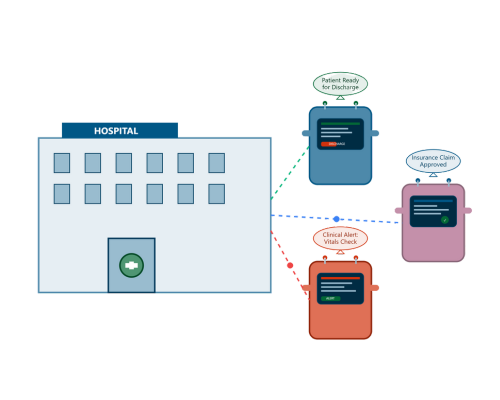
Imagine a healthcare system where digital agents coordinate patient discharge, resolve insurance claims, and support clinicians—all with minimal human intervention. This is not a distant vision; it is an emerging reality powered by AI agents.
In a recent article, McKinsey & Company explores how AI agents are poised to revolutionise healthcare operations. At RPATech, we are already turning that vision into practice, combining robotic process automation (RPA), intelligent document processing, and AI to create agent-based systems that boost efficiency, reduce errors, and unlock time for critical human judgment.
What Are AI Agents—and Why Do They Matter in Healthcare?
AI agents are autonomous, intelligent digital entities capable of performing complex tasks without constant human direction. Unlike simple bots or scripts, AI agents can reason, learn, make decisions, and collaborate with other agents. In healthcare, they offer enormous potential—from streamlining repetitive administrative workflows to enhancing patient support and reducing operational overhead.
McKinsey outlines a three-part AI agent framework:
- Orchestration agents: Coordinate task allocation and manage workflows
- Task agents: Execute specific activities like prior authorizations or discharge planning
- Supervisory agents: Monitor performance and escalate tasks as needed
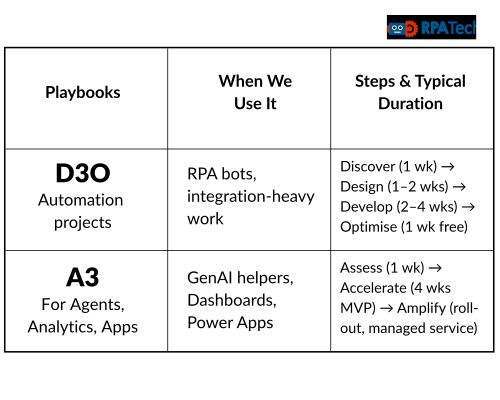
At RPATech, we implement this model using our Proprietary D3O (Discover, Design, Develop and Optimise) and A3 (Assess, Accelerate & Amplify) Frameworks to address key pain points across the healthcare value chain.
What Is the Role of AI Agents in Healthcare?
Healthcare organizations generate more data today than at any prior point in history.
Patient records, lab results, imaging reports, insurance communications, wearable device feeds, clinical notes — across dozens of systems that were largely never designed to talk to each other. The result is that the right information rarely reaches the right person at the right moment without significant human effort to move it there.
That coordination gap is where AI agents operate.
At a practical level, AI agents in healthcare serve as the connective layer between systems, teams, and workflows. They receive information, reason about what needs to happen next, take action across connected platforms, and adjust course based on the outcome — all without a human directing each individual step.
A physician, a billing coordinator, and a care manager each need different pieces of the same patient’s data at different moments. AI agents handle the routing, synthesis, and follow-through so that each person gets what they need without having to chase it.
The role of AI agents is not to replace clinical judgment. A physician decides how to treat a patient. An AI agent handles the documentation of that decision, the prior authorization for the recommended procedure, and the follow-up scheduling after discharge.
These are distinct functions — and keeping that boundary clear is what makes agentic deployments in healthcare both safe and effective.
In India specifically, where the doctor-to-patient ratio remains well below WHO-recommended levels across most states, this matters a great deal. When administrative tasks consume 35–45% of a clinician’s working day, AI agents represent a way to restore that capacity — not by hiring more people, but by removing work that should never have required clinical attention in the first place.
How AI Agents Work
Understanding how AI agents function technically helps healthcare leaders make better deployment decisions and ask better questions of vendors.
At the core, an AI agent combines several AI capabilities: large language models (LLMs) for natural language understanding, machine learning for pattern recognition, planning algorithms for multi-step task management, and integration tools that connect the agent to external systems and data sources.
The process in a healthcare setting moves through five stages:

- Perception: The agent gathers information from its environment — a new insurance denial, an incoming lab result, a scheduling conflict, or a patient questionnaire response. The source could be an EHR, a payer portal, a wearable device feed, or a structured database.
- Reasoning: The agent processes what it has perceived and builds a model of the current situation. If a patient’s lab result is flagged as abnormal, the agent checks it against the patient’s current medications, their diagnosis codes, and the relevant clinical protocol before deciding on a next step.
- Planning: The agent determines what sequence of actions is needed. For a claims denial, the plan might involve reading the denial reason, pulling supporting clinical documentation, reformatting the submission to match payer requirements, and queuing it for resubmission.
- Action: The agent executes the plan through API connections to the relevant systems — submitting the claim, drafting the clinical note, booking the appointment, or sending the patient communication.
- Evaluation and Adaptation: The agent checks whether its action produced the expected result. If the resubmitted claim is accepted, the task is complete. If it is rejected again, the agent identifies why, tries a different approach, or escalates to a human reviewer when the situation falls outside its operating parameters.
This feedback loop is what separates agentic AI from traditional automation in healthcare. A rule-based RPA bot executes step A, then step B, then step C — every time, regardless of what happens in between. An AI agent adjusts its path based on what is actually happening.
A Note on Human-in-the-Loop (HITL)
Well-governed agentic systems are configured with defined escalation points where a human must review before the agent proceeds. This is both a safety mechanism and a trust-building mechanism.
As the system demonstrates accuracy over time, HITL thresholds can be adjusted to allow greater autonomy in areas where the agent has proven reliable.
How Can AI Agents Be Used in Healthcare?
Healthcare organizations often struggle with legacy systems, fragmented data, and manual-heavy operations. Our AI-powered digital workforce integrates with EHRs, insurance platforms, CRM systems, and more — enabling secure, scalable automation.
Here is how RPATech helps translate the promise of AI agents into reality.
Claims Lifecycle Management
Before | Hours spent verifying data, coding procedures, and chasing documents |
With RPATech Agents | Auto-validation, clean submissions, and automated denial management |
With RPATech Agents, you get:
- Auto-validation of insurance data before a claim is filed
- Drafting and submission of claims with coding accuracy checks
- Tracking denials and triggering appeals with pre-filled templates
📊 67% of healthcare executives see the greatest AI opportunity in payer-provider coordination and claims integrity.
Agentic claims workflows address this directly — handling the variation in payer rules that manual processes simply cannot keep up with.
Appointment Scheduling and Intake
- Pre-visit triage agents gather symptoms, insurance details, and suggest care pathways
- Agents send personalized reminders, prepare intake forms, and alert staff in case of anomalies
- Post-visit, agents manage follow-up scheduling and monitor whether patients complete recommended next steps
Revenue Cycle Optimization
From coding and billing to payment reconciliation, AI agents ensure clean claim submissions, reduce cycle time, and escalate anomalies for human review.
The result: a shorter gap between service delivery and payment, with fewer claims requiring manual intervention.
Prior Authorization
Prior authorization is one of the most time-consuming administrative burdens in clinical practice.
An AI agent reads the physician’s order, identifies which procedures require authorization, gathers relevant clinical documentation from the EHR, formats the request to payer specifications, submits it, tracks the response, and manages the appeal if authorization is denied.
Clinicians and their staff reclaim hours each week that currently go into this process.
Clinical Documentation Support
Physicians spend between a third and half their working day on documentation — not because that work is clinically valuable, but because it is administratively required.
AI agents can listen to a clinical encounter (with appropriate consent protocols in place), generate a structured note, populate EHR fields, and flag documentation gaps based on the diagnosis codes being used. The physician reviews and signs off rather than writing from scratch.
Care Coordination Across Teams
In a multi-agent deployment:
- One agent manages referral tracking
- Another monitors test completion and result routing
- A third handles communication between the patient and the care team
Together, they ensure that nothing falls through the cracks between handoffs — a problem that currently requires significant coordinator time to manage manually.
Population Health and Chronic Disease Monitoring
AI agents can continuously scan a defined patient population for care gaps:
- Patients with diabetes who have not had an HbA1c test in six months
- Hypertensive patients with out-of-range readings who missed their last appointment
- Post-discharge patients who have not completed cardiac rehab enrollment
When a gap is identified, the agent triggers an outreach workflow — rather than waiting for a human to review a report and decide who to contact.
📊 4 in 10 healthcare executives already use AI for inpatient monitoring and early patient health warnings.
Bed Management and Patient Flow
An AI agent managing bed operations synthesizes discharge timelines, surgery schedules, current occupancy, and incoming emergency volume — simultaneously, in real time.
It alerts bed management teams to anticipated bottlenecks hours before they develop, identifies discharges pending only clinical sign-off, and coordinates housekeeping for rooms expected to turn over — all continuously, as conditions change throughout the day.
Why AI Agents in Healthcare?
The case comes down to a straightforward mismatch.
The data volumes, workflow complexity, and coordination demands of modern healthcare have outgrown what human teams can manage with existing tools.
Consider what existing tools actually do:
Tool | What It Does | Where It Falls Short |
EHR | Stores patient data | Does not coordinate care |
RPA | Automates fixed rules | Breaks when rules change |
Basic AI | Analyzes information | Does not take action |
AI Agents | Reasons, plans, and executes | Adapts as conditions change |
There is also a workforce dimension that is particularly relevant for India. A physician who is not writing notes sees more patients. A care coordinator who is not manually chasing referrals handles more complex cases.
AI agents do not solve the workforce supply problem — but they change how existing clinical capacity is allocated.
📊 34% of healthcare executives see AI’s greatest value in coordinating multidisciplinary teams across departments and between hospitals.
📊 Gartner predicts that by 2028, 33% of enterprise software applications will include agentic AI — up from less than 1% in 2024.
Healthcare is one of the sectors where adoption is accelerating fastest, because the coordination problems agents solve have been persistent, well-documented, and expensive for decades.
What Are the Benefits of AI Agents in Healthcare?
The benefits land across clinical, operational, and financial dimensions.
Benefit | What it delivers | Impact area |
Reduced administrative burden | Agents handle documentation, data entry, and workflow coordination — freeing clinical and administrative staff for work that requires human judgment. Reduces burnout without adding headcount. | Operational |
Faster revenue cycle | Agentic claims workflows catch errors before submission, cutting denial rates. Appeals move faster than manual processes. Cash flow improves as the gap between service delivery and payment shortens. | Financial |
Better care coordination | Agents maintain context across systems and teams, reducing handoff failures that cause delayed care, repeated testing, and preventable complications. | Clinical |
Consistent protocol application | An AI agent applies clinical guidelines, payer rules, and compliance requirements reliably at scale — eliminating the variation that occurs when manual processes are handled differently across staff and shifts. | Compliance |
Proactive patient outreach | Agents monitoring patient populations act on care gaps before they become clinical crises — shifting care from reactive to proactive, particularly for chronic disease management. | Clinical |
Faster response to change | When patient volumes shift, payer requirements update, or a new clinical protocol is introduced, agents adapt workflows faster than teams dependent on manual process updates. | Operational |
Scalability without headcount growth | A hospital growing from 300 to 600 beds does not need to double its administrative staff when agentic systems handle coordination, documentation, and claims workflows at scale. | Financial |
Audit-ready documentation | Agents generate logs of every action and decision they make. This audit trail supports NABH accreditation, internal quality reviews, and compliance with India’s evolving DPDP Act. | Compliance |
Our Implementation Method: Human-Centric, Tech-Enabled
At RPATech, we follow a step-by-step, risk-aware deployment strategy:
- Process Discovery & ROI Mapping
Identify high-volume, high-impact tasks suitable for automation - Pilot with Guardrails
Launch minimal viable agents with human-in-the-loop (HITL) checkpoints - Scale to Agent Ecosystems
Enable task collaboration and orchestration across workflows - Ensure Governance
Audit logs, compliance rules, escalation protocols built into every agent - Drive Adoption
Co-create with your teams, ensure seamless integration into day-to-day ops
RPATech's Implementation Method
Why Choose RPATech for AI in Healthcare?
- Platform-Agnostic: We work across your existing systems
- Domain Expertise: Deep understanding of healthcare and insurance workflows
- Fast Deployment: Rapid prototyping, and scalable architectures
- Quick ROI Realization: Well-defined outcomes, Quick ROI realization
Looking Ahead
McKinsey rightly notes that AI agents are “poised to redefine how work gets done.”
At RPATech, we’re not just observing the change — we are building it.
The next phase of agentic healthcare goes beyond individual workflows. Networks of agents will work together across departments, facilities, and organizations, sharing context and coordinating action in ways that require significant human effort today.
Organizations that build operational experience with agentic systems now — starting with contained, well-governed deployments — will be positioned to scale quickly as the technology matures.
For Indian healthcare organizations, the opportunity is significant. The scale of the patient population, the documented inefficiencies in administrative workflows, and the growing digital infrastructure all point toward agentic automation as a high-priority investment in the next 18–24 months.
If you are exploring how to bring AI agents into your healthcare operations, we are ready to partner with you — from strategy to deployment.
Let’s Talk About Building Your Digital Workforce