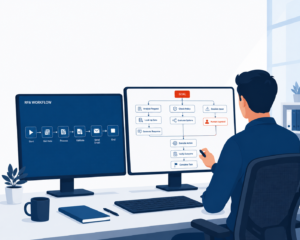

Agentic automation has become one of the fastest-moving conversations in enterprise technology. It is in analyst reports, board presentations, and technology roadmaps. Most business leaders are now expected to have a view on it, often before they have had the time to build one.
This guide is designed to close that gap. It covers what agentic automation is, how AI agents work, how this capability fits with the automation your organisation has already built, where the technology is genuinely ready and where it is still finding its footing, and what it takes to move from interest to action.
Whether the next step is training your team, evaluating a pilot, or simply being better equipped for the next time this topic comes up at the leadership table, the aim here is working clarity.
What Is Agentic Automation?
Agentic automation is automation powered by AI agents: software that can perceive a situation, reason about what needs to happen, decide on the right course of action, and execute across multi-step processes with minimal human direction at each step.
Agentic automation adds a decision-making layer above the process automation. Earlier, in case of exceptions, the bot used to alert humans. With agentic automation in the picture, an AI agent looks at what happened, weighs the goal, decides on the next best action, and continues.

Key Characteristics of an Agentic System
Three things describe an AI agent:
- Goal-directed reasoning: the agent works toward an outcome.
- Dynamic decision-making: it reads new or unexpected inputs and adapts.
- Autonomous multi-step execution: it can call tools, access systems, and coordinate across process stages without a human at every handoff.
How Agentic Automation Fits Your Existing Automation Stack?
One of the more damaging claims circulating about agentic automation is that it replaces RPA. It does not, and the platforms building this technology are direct about it.
The arrival of AI agents does not make existing automation redundant. RPA handles high-volume, structured, rules-based work with a level of speed, precision, and reliability. There is no reason to move something that is running reliably simply because a new capability has arrived.
What changes is the layer above it. AI agents bring reasoning and judgment to the parts of a process that rules cannot cover: the missing document, the unusual claim, the exception that needs a decision before work can continue.
AI agents handle the thinking. RPA bots handle the doing. In most agentic deployments, the agent reasons about what needs to happen next, and existing RPA bots and system integrations carry out a large share of the actual execution. One does not replace the other. The agent decides. The automation acts on that decision.
Organisations that have invested in building a solid RPA and automation foundation are in a better position to adopt agentic capabilities, not a worse one. The bots, integrations, and process logic already in place are exactly what an agent needs in order to act on its decisions.
How Agentic Automation Works?
Business leaders do not need to understand the engineering of agentic systems in depth. But understanding the mechanics at a working level changes how you scope it, govern it, and evaluate the vendors selling it.

The Perceive, Reason, Plan, Act, Learn Loop
Every agentic system runs a continuous cycle:
- Perceive: gather information from systems, documents, and data sources available to the agent.
- Reason: interpret what the information means in the context of the goal.
- Plan: determine the sequence of actions most likely to achieve the outcome.
- Act: execute across systems, APIs, or human touchpoints.
- Learn: use the outcome to refine how the system approaches similar situations in the future.
This loop is what allows an agentic system to handle exceptions that would stop a standard bot. Instead of pausing, it keeps working within its defined boundaries.
Single-Agent vs Multi-Agent Orchestration
A single-agent system handles one workflow or domain. A multi-agent system coordinates specialised agents under an orchestrator, each responsible for a different part of a larger process.
Multi-agent architectures are more capable but also more complex to govern. For most organisations, the right starting point is one agent on one well-defined, bounded process. Not an orchestrated network spanning the enterprise.
Where Language Models and Generative AI Fit?
Language models are a component inside an agentic automation system. They provide the reasoning and language understanding that gives the system its judgment. The execution, system integration, workflow logic, and governance are all built on automation infrastructure.
This matters because it prevents a common mistake: assuming that having access to a language model is the same as having agentic automation capability.
Why Agentic Automation Matters Now?
The technology has been developing for years. What has changed is that it has matured enough to move from research into enterprise production. Three things are converging to make this the right moment for business leaders to take it seriously.
- The technology is production-ready. Language models are reliable enough for structured tasks and the tooling for building agentic workflows on enterprise systems is available and tested.
- Enterprise processes have outgrown rules-based automation in specific areas. The value left on the table is not in high-volume, clean, structured processes that standard automation already handles well. It is in the messy middle: processes with high manual intervention, partial data, and decisions that do not fit a fixed script.
- The cost of human coordination keeps rising. Every time a case sits in a queue waiting for someone to make a judgment call, that is time and money. Agentic automation can reduce that friction in a way that earlier automation could not.
The question is not whether this matters. The question is whether your organisation is ready to act on it and what that actually requires.
Separating the Hype from the Reality
The noise around agentic automation is real, and some of it is useful signal. A fair amount of it, however, is vendor positioning dressed as industry insight. A business leader trying to make a good decision needs to know the difference.
What Is Real?
In production environments with well-defined scope and proper AI governance, agentic systems can handle genuinely complex, multi-step workflows that earlier automation could not. They reduce cycle times, cut exception volumes, and free up skilled workers for higher-judgment tasks. The operational benefit is real where it has been done right.
What Is Overstated?
The claim that agentic automation is ready to run autonomous enterprise operations without meaningful human oversight is not accurate for most organisations. The technology is capable. The organisational conditions required to run it safely, with clear ownership, workflow redesign, governance, and training, are significantly harder to build. Most organisations are not there yet.
The 40% Cancellation Problem
Gartner forecast in June 2025 that over 40% of agentic AI projects will be cancelled by the end of 2027, citing cost escalation, unclear business value, and inadequate risk controls.
This is not an indictment of the technology. It is a description of what happens when organisations move into agentic automation without ownership clarity, process foundations, and governance in place. The technology works. The organisational conditions often do not.
Agent Washing: A Practical Guide to Spotting It
Agent washing is the practice of rebranding existing automation products — RPA bots, chatbots, workflow tools, or rule-based systems — as “agentic” without the underlying capability that genuine agentic automation requires.
A significant number of vendors have renamed existing products as ‘agentic’ without the underlying capability. Gartner estimated that of the thousands of vendors claiming agentic capability, only a small fraction deliver genuine agentic systems. The rest are rebranding RPA bots, chatbots, or workflow tools.
The bar is clear: automation powered by an AI agent that can genuinely perceive, reason, and act on its own across dynamic situations. A rebranded bot that still breaks when a user interface changes, with no real reasoning behind its actions, does not clear that bar, whatever the product sheet calls it.
The simplest test: ask the vendor for a production example, not a demo. Ask how the system handles an exception it has not seen before. Ask what happens when the data is incomplete.
Governance, Risk, and the Human-in-the-Loop Principle
Agentic automation takes actions in your systems. Unlike a report or a recommendation, it actually does things. That changes the governance requirements.
Where Projects Fail
Most agentic automation failures are not technology failures. They are governance failures. No clear ownership. No process redesign before deployment. No defined exception handling. No audit trail. No rollback plan. When something goes wrong and nobody knows who is accountable, initiatives get shut down.
The 40% cancellation rate is not driven by bad technology. It is driven by good technology inside organisations that were not ready to run it.
When Not to Use Agentic Automation
Not every process benefits from agentic automation. If a process is high-volume, clean, structured, and already handled well by rules-based automation, adding an agentic layer introduces cost and complexity without proportionate return.
Agentic automation earns its place in processes where exceptions are frequent, data is variable, or real-time judgment across systems is required. Use the right tool for the job.
Human-in-the-Loop as a Design Principle
The most successful agentic automation deployments are designed with human checkpoints from the start. This means defining upfront which decisions the agent can take autonomously, which require human review, and what happens when the agent’s confidence falls below an acceptable threshold.
Human-in-the-loop is not a limitation on the technology. It is good design. It also makes governance more tractable because accountability is clear at every stage.
Governance Essentials
Before any agentic system goes live, these questions need written answers:
- What can the agent do, and what is it explicitly prohibited from doing?
- Which data can it access, and under what conditions?
- How is every action logged, and for how long?
- Who reviews performance, and at what cadence?
- Who can pause or shut down the agent, and how quickly?
- What is the rollback plan if accuracy drops?
If the AI governance framework cannot answer these questions before go-live, it is not finished.
Building Your Agentic Automation Roadmap
The practical challenge of moving from interest to production is where most organisations get stuck. Alok Mani Tripathi, Founder and CEO of RPATech, has published a detailed implementation guide on this topic. While that guide is written for healthcare CIOs, the framework underneath it applies across industries. Read the full article here: Moving from Pilot Purgatory to Production: A CIO’s Roadmap to Healthcare Agentic Automation.
The universal version of that roadmap, distilled from the same principles, works like this:

Step 1: Stop Funding Pilots Without Production Budget
A pilot that has no defined path to production is a demo with a budget attached. Before approving any agentic automation initiative, answer three questions: Who will run this in production? What is the production budget? What does the controlled rollout look like?
If those answers are not ready, the project is not ready.
Step 2: Define the P&L Owner for Agentic AI
Agentic automation is cross-functional by design. The automation team owns the platform and the technology risk. A business leader must own the business outcome. Both are necessary, and the split should be written into the programme charter, not agreed informally in a meeting.
Step 3: Pick Production-Ready Use Cases, Not Fancy Use Cases
High-visibility use cases make good demos and poor first deployments. High-volume, operational workflows with measurable cycle times and clear exception paths are better production candidates. They have the volume to show results and the structure to keep governance manageable.
Step 4: Redesign the Workflow Before Deploying the Agent
Existing processes were designed for humans moving work manually across systems. Automating a broken process makes it break faster. Before any agentic deployment, the workflow needs redesigning: where the agent starts, what data it needs, which decisions it can take, which need human review, and how exceptions are routed.
No workflow redesign document, no production deployment. This is the step that separates organisations that get lasting value from those that get expensive pilots.
Step 5: Build Governance That Works in Practice
Governance should answer operational questions, not just policy ones. What can the agent do? What needs a human sign-off? How is every action logged? Who reviews performance? Who can shut it down? Governance that lives only in a policy document is not governance.
Step 6: Communicate the Change Before Rollout
Staff who first hear about an agentic system on go-live day will be suspicious of it. Communication should start before deployment, explain what the agent does and does not do, make clear that humans remain in control of exceptions and judgment calls, and come from both business and technology leadership, not just IT.
Step 7: Train Teams for Human-Agent Operations
Agentic automation changes how people work with their processes. That requires preparation, not just documentation handed over at launch. Training before go-live reduces errors, speeds adoption, and builds the internal confidence that sustains the initiative past the honeymoon period.
Step 8: From Project Thinking to Product Thinking
A project has a deadline. A production agent needs a lifecycle: monitoring, improvement cycles, performance reviews, and governance check-ins. The organisations that get lasting value from agentic automation are the ones that treat it as a live capability, not a completed deliverable.
For Alok’s full roadmap, including the 90-day action plan and ownership accountability table, read the complete article: CIO’s Roadmap to Healthcare Agentic Automation.
Getting Your Team Ready for Agentic Automation
Technology decisions often move faster than people decisions. A business leader can approve an agentic automation initiative. But if the team responsible for running it does not understand how to work with agents, the gap between what was approved and what actually happens in production is significant.
This is the readiness problem most organisations underestimate.
What the Capability Gap Looks Like in Practice
Automation professionals who know rules-based automation well understand process decomposition, exception handling, and system integration. Agentic automation calls on additional skills: understanding how language models reason, designing workflows for human-agent collaboration, setting up monitoring and governance, and knowing when to use an agent versus when a rules-based bot is the better choice.
Most teams have some of this. Few have all of it. The gap is real, and it affects every stage of an agentic initiative from scoping through to support.
Who Needs to Be Trained and on What
Different roles need different depth:
Role | What they need to understand |
Automation CoE leads and architects | Agentic system design, tool selection, multi-agent orchestration, governance architecture |
Process owners and business analysts | How to identify agent-ready workflows, design human-agent handoff points, define success metrics |
IT and operations managers | Monitoring, security, access controls, incident response, performance review |
Programme and project managers | How to scope, govern, and measure agentic initiatives from initiation through to production |
The goal is not to turn every team member into an AI engineer. The goal is to create an organisation that can evaluate, implement, govern, and continuously improve agentic automation from the inside.
The Business Case for Training Before Deployment
Teams that understand agentic automation before they work with it make better scoping decisions. They catch governance gaps before they become incidents. They adopt new workflows faster because they are not learning the technology and the process change at the same time.
Training is not a soft investment. It reduces the probability of the kind of failure Gartner is describing in its cancellation projections: poorly scoped initiatives, unclear ownership, and governance that exists on paper but not in practice.
RPATech’s Agentic Automation Training is built for teams that want practical capability. As a UiPath Agentic Automation Fast Track partner, the training covers tools, workflow design, governance frameworks, and the methodologies that carry a team from understanding to production.
Designed for automation professionals, CoE leads, process owners, and IT teams, it builds the internal muscle your organisation needs to run agentic automation reliably over time.
➤ Explore training options: rpatech.ai/agentic-automation-training
Where to Go from Here
Agentic automation is not a technology problem waiting to be solved. For most organisations, it is an organisational readiness problem waiting to be addressed.
The technology is ready for production. The conditions that make production successful, clear ownership, trained teams, redesigned workflows, and governance that works in practice, take deliberate work to build.
Schedule a consultation with our team
Frequently Asked Questions
What is agentic automation?
Agentic automation is automation powered by AI agents: software that can perceive a situation, reason about what needs to happen, decide on the right course of action, and execute across multi-step processes with minimal human direction at each step. This gives enterprise processes something they did not have before: the ability to handle judgment calls without waiting for a human to step in.
Is agentic automation the same as agentic AI?
Not quite. Agentic AI is the underlying technology: language models and AI agents capable of reasoning, planning, and acting on their own. Agentic automation is what happens when that technology is applied inside a real business process, combined with the execution infrastructure, bots, APIs, integrations, and workflow logic, needed to actually complete the work.
Does agentic automation replace RPA?
No. RPA handles high-volume, structured, rules-based work with speed and precision that an AI agent is not designed to replicate. Agentic automation adds a reasoning layer that handles the exceptions, variability, and judgment calls that rules-based systems cannot. In most deployments, AI agents decide and RPA bots execute a large share of the resulting work. The two work together, not in competition.
Why do so many agentic automation projects fail?
Most failures are governance and ownership failures, not technology failures. Gartner’s forecast that over 40% of projects will be cancelled by 2027 points to cost escalation, unclear business value, and inadequate risk controls as the primary causes. Poor scoping, no defined production path, and teams that were not trained before deployment are the practical drivers behind those numbers.
How do you start with agentic automation?
Start with a single, bounded process that has high exception volume, measurable cycle time, and clear data availability. Assign business ownership before the pilot begins. Define what the agent can and cannot do, build governance before production, and train the team before go-live. Do not approve a pilot without a production plan.
What does agentic automation training involve?
Effective training covers how agentic systems work, how to design workflows for human-agent collaboration, how to identify processes that are ready for agents, governance and monitoring, and platform proficiency. RPATech’s training is built around practical application, not just conceptual understanding, and is designed for automation professionals, process owners, and IT teams.
How is agentic automation governed?
Governance should answer operational questions before go-live: what the agent can do, which data it can access, how every action is logged, who reviews performance, and who can pause or shut down the system. Human-in-the-loop checkpoints should be designed in from the start, with clear thresholds for when the agent passes a decision to a human reviewer.