
The certification clock, the skill gap, and what actually changes when bots start reasoning instead of just executing.
On October 15, 2023, two certifications that helped RPA developers build careers expired after a decade. UiPath’s RPA Associate (UiRPA) and Advanced RPA Developer (UiARD) credentials were retired, and anyone still holding one is valid until October 15, 2026, before it expires completely.
That expiry date matters less as a certificate problem and more as a signal. A vendor does not retire a decade-old exam track for a marketing refresh. It retires it because the job the exam measured stopped matching the job the market hires for. UiPath replaced the old track with the Automation Developer Associate and Automation Developer Professional certifications, then went further by adding a dedicated Agentic Automation Associate exam built around a different skill set entirely: agent blueprint design, context grounding, agentic prompt engineering, escalation design, and agent evaluation.
None of that means the RPA developer’s job disappeared. It means the job description moved, specifically enough that the platform which trained a generation of RPA developers rewrote its own exam to match. That is the actual case for upskilling. Not because agentic automation is fashionable, but because the tooling underneath the job already changed.
The Shift Isn’t Cosmetic
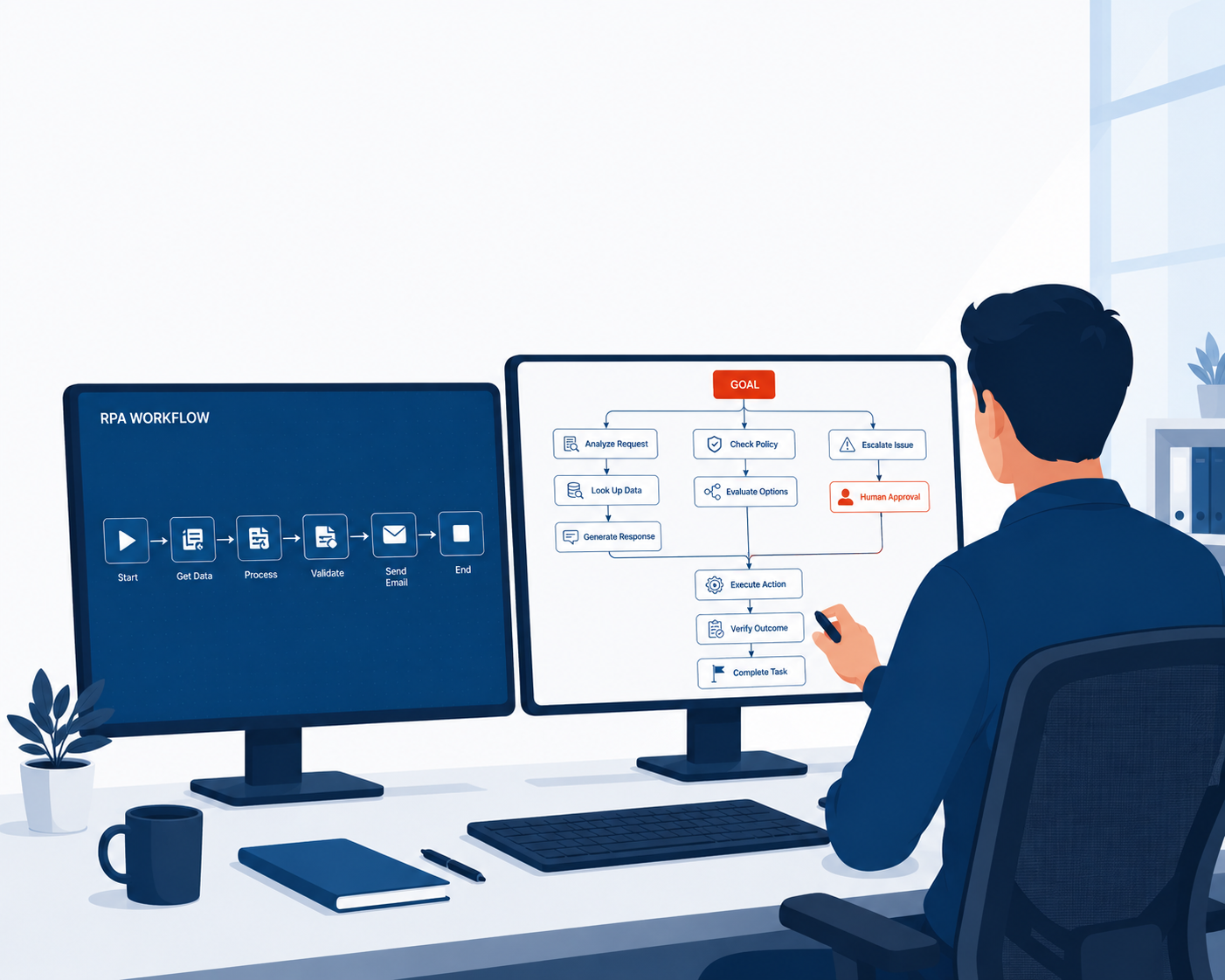
Traditional RPA logic is deterministic. A developer maps every click, every field and every exception path in advance, and the bot executes exactly what was scripted. Agentic automation works on a different principle. Instead of a fixed sequence, a developer defines a goal, a set of available tools and a set of constraints, and the agent reasons about how to get from input to outcome, adjusting its plan when the situation doesn’t match what was expected.
UiPath’s own community engineering team puts the distinction plainly: agents think, robots do. Agents don’t touch enterprise systems directly. They call RPA workflows, APIs and functions the way a person delegates a task to a tool, then check whether the result actually moved things closer to the goal. That separation between reasoning and execution is what makes agentic automation something a team can govern, rather than something that behaves unpredictably once it scales past a demo.
For a developer, the difference shows up as a different job day to day:

| Traditional RPA | Agentic Automation | |
|---|---|---|
| Logic | Every step mapped in advance | Goal defined, agent plans the path |
| Failure mode | Breaks when the interface changes | Adapts, but can misjudge context |
| Core skill | Selector mapping, exception handling | Agent design, context grounding, evaluation |
| Governance need | Audit trail of fixed steps | Human-in-the-loop checkpoints, escalation rules |
What RPA Developers Actually Need to Learn
Six areas separate a developer who can operate inside this shift from one still building for a world that already moved on.
- Agent blueprint design. Defining an agent’s goal, role, available tools and limits before a single line of orchestration gets built. This sits closer to solution architecture than scripting.
- Context grounding: Making sure an agent reasons against the right data, not whatever happens to be nearby. Ungrounded agents guess. Grounded ones check first.
- Agentic prompt engineering. Different from consumer prompting. The prompt has to constrain behavior inside a business process, not just produce a good-sounding answer.
- Human-in-the-loop escalation design. Deciding in advance exactly which decisions an agent can make alone and which ones stop for a person. A design decision, not something bolted on after launch.
- Agent evaluation. Deterministic bots either pass a test case or they don’t. Agents need ongoing evaluation against drift, inconsistency, and edge cases nobody anticipated at build time.
- Orchestration across the existing estate. Most enterprises are not ripping out RPA. They are layering agents on top of it, which means a developer has to know how to route between the two, not just build one or the other.
None of these is exotic. They are learnable, largely through the same instructor-led, hands-on format that built RPA competency in the first place.
The RPA Background Is a Head Start, Not a Handicap
None of the six skills above replaces what an RPA developer already knows. Process-mapping instinct, exception-handling discipline, familiarity with Orchestrator and a working sense of how a business process actually breaks under pressure all transfer directly.
That matters because most enterprises aren’t choosing between RPA and agents. They’re combining both: agents at the reasoning layer, RPA and existing scripts still handling the deterministic, high-volume execution work, particularly against legacy systems that don’t expose an API. A developer who already understands where RPA holds up and where it doesn’t is better placed to decide where an agent belongs in that architecture than someone arriving from a pure AI background with no enterprise process experience.
The upskilling case, in other words, isn’t “learn a new field from zero.” It’s “add six specific capabilities on top of what already works.”
Why the Hype Cycle Warning Cuts in the Trained Developer’s Favour
Gartner has forecast that more than 40% of agentic AI projects will be cancelled by the end of 2027, and named the reasons plainly: escalating costs, unclear business value and inadequate risk controls. Notably absent from that list: the model wasn’t good enough. Every failure mode Gartner named is a governance and design problem, exactly the territory the six skills above cover.
Gartner has also flagged what it calls “agent washing,” where RPA tools and chatbots get rebranded as agents without any real agentic capability behind them, and estimates only around 130 of the thousands of vendors claiming agentic capability are building something that earns the label. That’s a market still sorting real capability from repackaged marketing, and the same sorting is happening inside enterprise teams right now. A developer who can design proper escalation paths and evaluation criteria is often the difference between a project that survives that sort and one that gets cancelled at the next budget review.
The adoption gap backs this up. By Gartner’s own numbers, only 17% of organisations have deployed AI agents so far, while more than 60% expect to deploy within two years. That gap between intent and deployment is exactly where trained developers get pulled in. Somebody has to move each of those organisations from “plans to deploy” to “deployed and still running eighteen months later,” and that is a build-and-govern skill set, not a slide-deck skill set.
What This Means for Automation CoEs, Not Just Individual Developers
The upskilling decision rarely rests with a single developer. It usually lands on whoever runs the automation Centre of Excellence or the RPA practice within an IT services team, which changes the question from “should I learn this” to “how many people need this, and in what order.”
Three practical calls tend to come up early. First, batch versus individual training: certification vouchers and instructor-led delivery scale far more predictably across a team than sending one developer to a self-paced course and hoping the knowledge spreads. Second, sequencing: a bench that upgrades its strongest developers first, then uses them to mentor the rest, moves faster than training everyone at once against unfamiliar material. Third, and easy to overlook, is that a CoE upgrading its own developers is a materially different, and usually faster, path than hiring externally for agentic skills that are still scarce in the market. The developers already understand the business processes; what they’re missing is a specific, learnable set of new capabilities, not a different career.
Where to Start
The most efficient path mirrors how RPA competency was built in the first place: an official curriculum, instructor-led delivery, and a capstone built around a real process rather than a generic exercise.
UiPath’s retooled certification track is the obvious anchor point, since it runs on the same platform most RPA developers already know, now assessed against agent blueprint design, context grounding, escalation and evaluation rather than legacy selector-based automation. Instructor-led programs built around that curriculum, delivered with labs and a capstone tied to a client’s own use case rather than self-paced video, tend to get teams through it with far higher completion rates than self-study achieves. RPATech delivers exactly this kind of Agentic Automation Developer training as a UiPath Authorised Academy Delivery Partner, with exam vouchers bundled for teams that want the certification outcome alongside the hands-on build.
Talk to us about Agentic Automation Developer Training – Trained-led
For teams sitting on an existing RPA estate rather than starting fresh, the more useful question usually isn’t about learning agents in the abstract; it’s about evolving what’s already running. That’s a more applied problem: which processes are ready for an agentic upgrade, where human-in-the-loop checkpoints belong, and how to redesign existing automations without having to start over. RPA-to-Agentic Modernisation programs exist specifically to work through that question against a team’s own bot estate rather than a hypothetical one.
Either starting point beats waiting. The certification clock is already running, the skill gap is specific and namable, and the developers who close it now will be the ones enterprises lean on once the current wave of agentic projects gets sorted into what survives and what gets cancelled.
Frequently Asked Questions
1. Is RPA becoming obsolete because of agentic AI?
No. Most enterprises are combining both rather than replacing one with the other. RPA remains the more reliable, lower-cost choice for high-volume, rule-based tasks on legacy systems, especially where no API exists. Agents typically sit above that layer, handling judgment calls and unstructured input, and often call existing RPA workflows as tools rather than replacing them outright.
2. What new skills does agentic automation actually require that RPA didn’t?
Agent blueprint design, context grounding, agentic prompt engineering, human-in-the-loop escalation design, agent evaluation, and orchestration across a mixed bot-and-agent estate. Selector mapping and deterministic exception handling still matter, but they are no longer the whole job.
3. Do RPA certifications still matter in 2026?
The certifications that defined RPA developer credentials for most of the last decade, RPA Associate and Advanced RPA Developer, were retired in 2023 and expire entirely on October 15, 2026. The path forward runs through Automation Developer Associate and Professional tracks, plus a dedicated Agentic Automation Associate certification built around agent design rather than legacy scripting.
4. How long does it take an RPA developer to become agentic-ready?
Most instructor-led agentic automation developer programs run three to five days of hands-on training, built around labs and a capstone project, on the assumption that participants already understand core automation concepts. That covers the technical build layer. Applying it against a real bot estate, including where to place human oversight, is a separate, ongoing exercise rather than a one-time course.
5. What’s the actual difference between an AI agent and an RPA bot?
An RPA bot follows a fixed, pre-mapped sequence of steps and breaks when the interface or process changes. An AI agent is given a goal, a set of available tools and constraints, and reasons about how to reach the outcome, adjusting when circumstances shift. The agent decides what needs to happen; RPA, where it’s still in the picture, often executes the deterministic part of that decision.
6. Should an RPA team rebuild its existing bots as agents right away?
Not wholesale. The more defensible approach starts with an audit of the existing estate: which bots are stable and cheap to maintain as they are, which ones fail often enough to be strong candidates for an agentic upgrade, and which processes were never automated in the first place because they involved too much judgment for classic RPA to handle. That audit, not a blanket rebuild, is usually the first deliverable of a modernisation engagement.


