
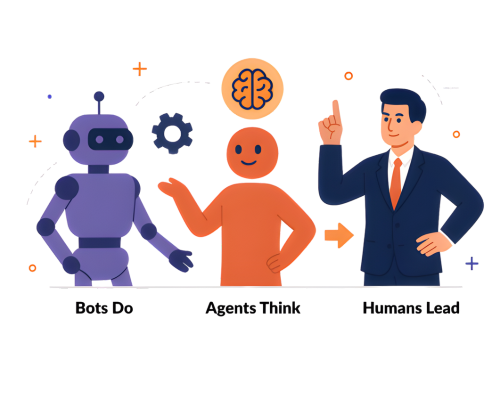
The conversation around automation has fundamentally changed. It’s no longer just about making repetitive tasks faster; it’s about building systems that can actually think, reason, and adapt to the messy reality of business operations.
In a recent LinkedIn Live session, Alok Mani Tripathi, Founder & CEO of RPATech, and Rajesh Undaviya, RVP Enterprise Business at UiPath, sat down to demystify agentic automation. And why it matters for businesses trying to navigate increasingly complex enterprise environments.
The Evolution of Agentic Automation
Automation didn’t arrive fully formed. It’s been a journey through three distinct phases, each building on what came before.
First came simple task automation—straightforward, repetitive actions that machines could handle better than humans.
Then we saw the breakthrough of Robotic Process Automation (RPA), which allowed organizations to streamline entire processes based on rule-based structured data. RPA was powerful because it brought real operational efficiency and cost reduction. As AI capabilities like machine learning, OCR, and natural language processing matured, this second phase expanded further, enabling automation to handle document understanding and extract data from unstructured sources.
Now we’re entering the third phase: agentic automation. The difference? These aren’t just bots following instructions. They’re autonomous AI agents capable of thinking, reasoning, learning, and making decisions with minimal human intervention.
Why Agentic Automation
You might be wondering why this matters right now. The answer lies in the sheer complexity of modern enterprise operations.
Large organizations today are running more than 175 different applications and systems—a mix of legacy platforms, on-premise solutions, and cloud applications, many operating in silos. Traditional RPA struggles to drive end-to-end workflow automation across processes like procure-to-pay or order-to-cash when they cut through all these disconnected systems.
Add to this the fact that business environments are constantly changing. Systems get updated, workflows evolve, business rules shift. Traditional RPA is essentially static automation—it executes instructions but can’t adapt to changing circumstances in real time. Agentic automation fills this gap because it’s context-aware and ready to respond to dynamic environments.
As Alok and Rajesh emphasized during the session, earlier automation needed perfect inputs. Agentic automation addresses complex tasks and unstructured data at the necessary speed and accuracy because the underlying AI allows systems to deal with messy real-world data.
Bots Do, Agents Think, Humans Lead
Perhaps the most memorable insight from the session was this simple framework: “Bots do, agents think, and humans lead.”
Think of it this way. RPA bots function like reliable tools—they execute tasks exactly as programmed, handling high-volume, predictable work with efficiency.
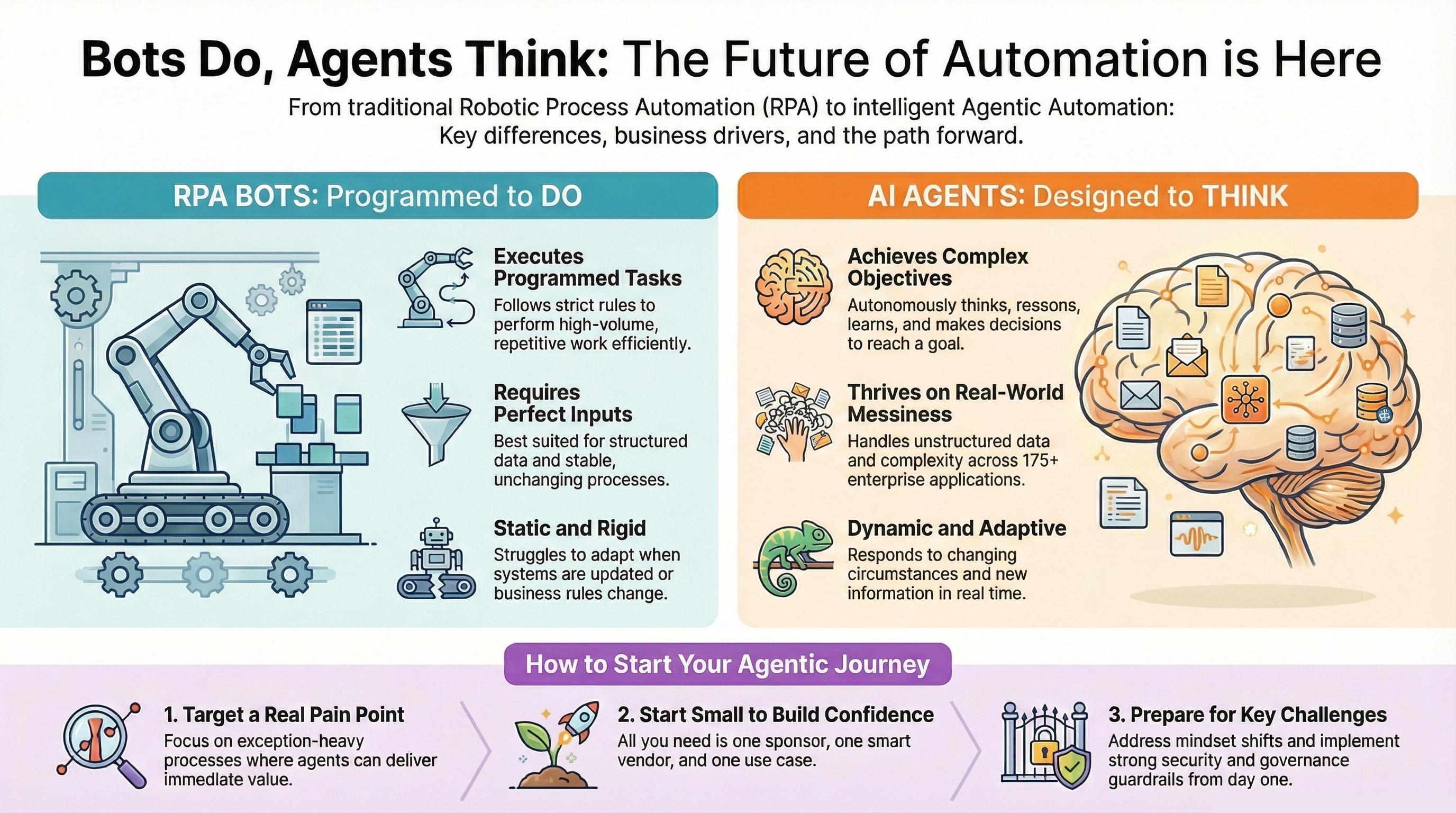
Agentic automation, by contrast, functions more like that junior who can read an email, think through the implications, and decide on the appropriate action based on the objective you’ve given them.
This doesn’t mean RPA is becoming obsolete. Far from it. RPA remains the foundation for predictable, high-volume tasks. Agentic automation complements and builds upon that foundation, bringing exponential impact rather than incremental gains.
Real Agentic Automation Use Cases Already Delivering Results
The conversation wasn’t purely theoretical. Both speakers shared examples of organizations already seeing success with early agentic deployments.
A large global insurance company implemented agentic automation for claim management.
A global manufacturing company in India deployed it for HSN code compliance—essential for GST tax reconciliation, international trade, and customs clearance.
A large agri-retail company is using it for vendor invoice validation, checking supplier names, rate cards, and systems data as invoices arrive from various sources. The same company also deployed agents for bank statement reconciliation, handling complex formats and multiple statements received at different frequencies from various banks.
What these use cases have in common is that they target existing organizational pain points and exception-heavy processes—exactly where agentic automation delivers the most immediate value.
Agentic Automation Challenges
No technology shift comes without challenges, and Alok and Rajesh were refreshingly honest about what early adopters are facing.
1. Mindset Challenge and the Human Role
The first challenge is mindset. There’s genuine apprehension about what happens when decision-making gradually shifts to AI agents. What becomes of the human role? Organizations need to reframe this question. The objective of agentic automation isn’t to eliminate human roles—it’s to free up human bandwidth for high-impact work like strategic thinking, complex problem-solving, and creativity.
2. Security and Governance Risks
The second challenge is governance and security. When you integrate autonomous AI agents into business operations, you’re exposing massive amounts of organizational data to these systems. That puts organizations at risk in terms of security and confidentiality. Governance isn’t optional—it’s absolutely critical. Organizations must put necessary guardrails around governance, security, and trust from day one.
How to Actually Start Your Agentic Journey
If you’re wondering where to begin, the advice from the session was pragmatic and actionable.
The decision on where to start depends on the nature of your work, not necessarily your organization’s maturity level. If you’re dealing with structured, straightforward processes, RPA is still the fastest and most cost-effective entry point. But if your processes are messy, unstructured, conversational, or involve reasoning and human loops at multiple points, it makes sense to start directly with the agentic model.
Leaders should target processes that are current pain points where lots of exceptions are happening. These are your clear-cut first use cases. Quick wins include reading emails, summarizing documents, handling exceptions, and analyzing logs.
The key is to start small and build confidence. Add one agentic component to an existing workflow. Use a large language model to read unstructured input for email segregation, or let an agent make decisions on exceptions encountered. Focus on assistance first, then move toward autonomy once your teams understand how to work with these systems.
You don’t need a massive budget or a new AI team to start. What you need is one sponsor within the company, one smart vendor, and one use case. A safe sandbox and proper guardrails are sufficient to build confidence and get moving.
The Implementation Mindset Shift
Perhaps the most important takeaway from the session was the shift in how we think about implementation. The approach changes from building task bots to building outcome systems. Instead of scripting every step, you’re defining objectives, establishing decision logic, determining where human or machine learning loops fit, and setting safety boundaries.
This is less about throwing away old automation work and more about redesigning for autonomy. If your existing automations are stable and well documented, extend them with AI components and agent-style decision blocks. If workflows are rigid or outdated, a rebuild might be necessary.
The Path Forward
The shift to agentic automation isn’t a distant future scenario—it’s happening now. Organizations across industries are taking those first steps, learning what works, and building the muscle memory needed to work alongside thinking systems.
The question isn’t whether your organization will need agentic automation. Given the complexity of modern enterprise environments and the constant pace of change, it’s increasingly clear that traditional automation approaches won’t be sufficient on their own. The real question is how you’ll approach the transition—strategically, with proper governance, and with a clear understanding of where agents add the most value.
As Alok and Rajesh made clear during the session, this evolution is about augmenting human capability, not replacing it. It’s about freeing your teams to focus on the work that truly requires human judgment, creativity, and strategic thinking—while autonomous agents handle the complexity, make sense of unstructured data, and adapt to changing circumstances in real time.
Watch the LinkedIn Live here:
Want to explore how agentic automation can solve real challenges in your organization?
RPATech offers specialized Agentic Automation Training designed for enterprises that want to build in-house capability to design, deploy, and manage autonomous AI agents. Equip your teams with the skills needed to move from traditional automation to intelligent, self-directed systems.
Learn more about the training here:


