
When you’re in the automation business long enough, you start seeing patterns. Not just in the documents you’re processing, but in the problems your clients keep running into.
For us at RPATech, one challenge kept coming up again and again: invoice extraction that’d actually work.
Last week, our Founder & CEO, Alok Mani Tripathi, sat down with Sibani Sekhar, VP-Marketing, RPATech, for a LinkedIn Live session to share the story behind DocXtract, our AI-powered invoice data extraction API. If you’ve ever dealt with invoice processing at scale, what he shared will probably sound familiar.
The Problem No OCR Was Really Solving
Here’s the thing about traditional invoice data-extraction tools: they work great—until they don’t.
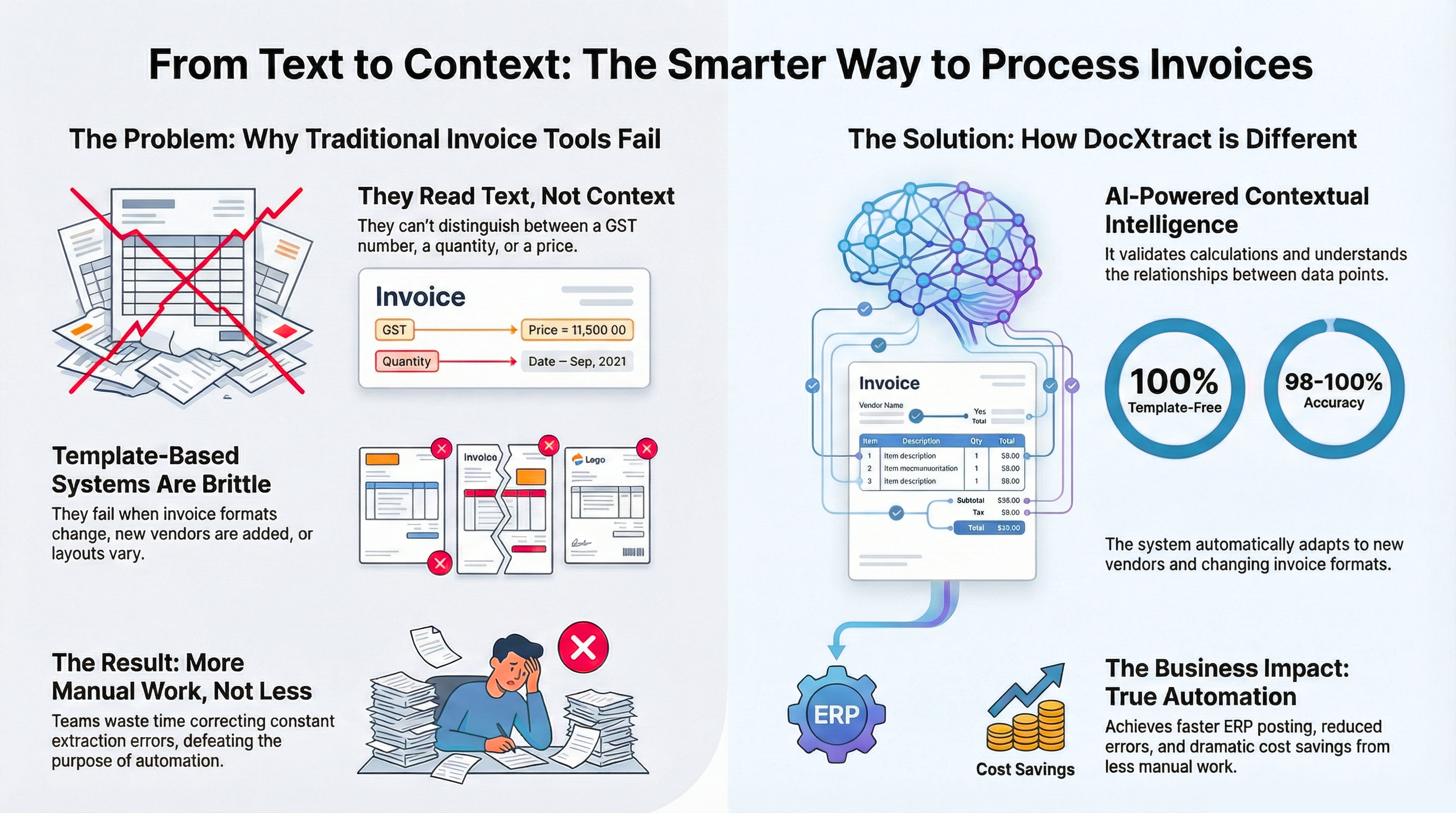
Most OCR and template-based tools read text just fine. They can spot a number, identify a date, pull out a vendor name. But they don’t understand context. They can’t tell the difference between a GST number, a quantity, or a price. They just see numbers in locations on a page.
“Traditional OCRs and template-based tools fail when invoice formats change, when new vendors are added, when tables break across pages, or when there are stamps and signatures on the invoice,” Alok explained during the session. “They read text, but not context.”
The result? Manual workarounds. Lots of them. Teams end up reviewing extracted data line by line, correcting mistakes, fixing mismatched fields. The automation that was supposed to save time ends up creating just as much work—sometimes more.
We heard this story from client after client. And we realized the market needed something fundamentally different.
How DocXtract is Different from Other OCRs
DocXtract was built from the ground up to understand context, not just text.
It’s a multi-modal AI engine powered by large language models (LLMs) that can recognize patterns, relationships, and structure within documents. When it sees a number, it doesn’t just note where it is on the page—it understands what role it plays in the invoice’s logic.
Contextual intelligence, not just text recognition
DocXtract analyzes how different data points relate to each other. It validates arithmetic consistency—making sure line totals actually add up to subtotals, and subtotals match the final amount. It uses what Alok calls “rule guards” to ensure calculations make sense, not just that text was extracted cleanly.
The system generates confidence scores based on contextual understanding, not just extraction quality. This means you get reliable results even when formats vary, layouts change, or documents aren’t perfectly clean.
Template-free processing
One of the biggest headaches with traditional systems is maintaining templates. Every time a vendor updates their invoice format or you onboard a new supplier, someone needs to create and test a new template.
DocXtract eliminates that entirely. It doesn’t use templates at all, maintaining 98-100% accuracy even when layouts change completely.
New vendor? No problem.
Format update? The system adapts automatically.
Built for real-world integration
We designed DocXtract to be developer-friendly because we know implementation matters as much as technology.
It integrates using a simple REST API and returns data in standard JSON format—making it straightforward to connect with your ERP system, accounting software, or automation platform. No complex configurations, no extensive customization. Just clean, structured data you can put to work immediately.
The Business Impact
When invoice extraction actually works, the benefits ripple through your entire accounts payable process:
- Faster ERP posting – Data flows directly into your system without manual intervention
- Reduced errors – Context-aware extraction means fewer mistakes to correct later
- Fewer reconciliation issues – When numbers add up correctly the first time, month-end closes faster
- Less vendor escalation – Accurate processing means fewer payment disputes
- Immediate cost savings – Manual review time drops dramatically
For organizations processing hundreds or thousands of invoices monthly, these improvements add up quickly.
Starting Where It Matters Most
While DocXtract is built as a general-purpose extrasction engine, we’re launching first with a focus on Indian invoices.
This isn’t random—we already had strong customer demand and early sign-ups asking specifically for a solution that handles the complexity of GST invoices, varied formats from Indian vendors, and the unique challenges of processing documents in this market.
“We’re starting with Indian invoice models because that’s where we saw immediate need,” Alok shared. “But the architecture is designed to expand.”
Looking ahead, we’re planning to extend DocXtract to other document types—bank statements, passports, KYC documents—and other geographies. The foundation is built to scale with whatever document challenges our clients face.
A Different Approach to a Common Problem
What struck me most during Alok’s session was how clearly DocXtract emerged from listening to real client struggles. This isn’t technology looking for a problem to solve—it’s a solution built because existing tools kept falling short.
If your team is still correcting OCR mistakes, maintaining template libraries, or manually reviewing extracted invoice data, you’re not alone. And you don’t have to keep accepting that as normal.
DocXtract represents a different approach—one where the technology understands what it’s reading, adapts to how your documents actually look, and integrates smoothly into how your team already works.
Watch the LinkedIn Live here:
Want to see how DocXtract handles your invoices? Get in touch to schedule a demo or learn more about bringing context-aware extraction to your AP process.


